
符号学习简介
概率逻辑系统
(Press ? for help, n and p for next and previous slide)
路径图
Final Project
Science World
https://github.com/allenai/ScienceWorld

Task
https://sciworld.apps.allenai.org/explore
- 选取其中的 1 个task,通过自己玩 or 用(比较强的) LLM 收集完成该任务的 examples (trajectory)
- 运用你学到的关于“程序归纳”的知识,实现一个简单的归纳算法,将上面的 examples 归纳为一个成功率较高的 program / workflow (命题 or 一阶均可)
- 撰写课程报告(ddl, 2026 年 1 月 11 日)
- 其他要求:
- 若你的 program / workflow 需调用大模型,请使用 10b 以下模型
- 为降低难度,可提供一定先置背景知识(如地图等),但关于任务执行本身的 Program / workflow 不能是手写的
- 报告中必须严格描述你如何将该任务形式化为一个逻辑归纳问题,并描述你的归纳算法
- 打分标准:技术报告的完成程度 + 选取任务的难度
符号学习简介・概率逻辑系统
- 从非经典逻辑到概率逻辑
- KBMC
- 分布语义
“真度”与“概率”
“真度”与“概率”
“真度”与“概率”
“真度”与“概率”
“真度”与“概率”
“真度”与“概率”
概率逻辑的语义
0.8::身上每处都淋到雨 被称为概率原子公式,它表示:
概率逻辑的语义
- \(\mathrm{Pr}(a\wedge b)=?\)
- \(\mathrm{Pr}(a\vee b)=?\)
- \(\mathrm{Pr}(\neg a)=?\)
- \(\mathrm{Pr}(a\rightarrow b)=?\)
- \(\mathrm{Pr}(a\mid b)=?\)
- \(\mathrm{Pr}(a,b)=?\)
符号学习简介・概率逻辑系统
- 从非经典逻辑到概率逻辑
- KBMC
- 分布语义
基于知识的模型构建
Knowledge-Based Model Construction (KBMC):构建一个具有逻辑结构的概率模型
- 起源于知识工程应对不确定推理的不足
- 决策支持系统(Decision Support System, DSS),1970s
- 先决条件是贝叶斯网的出现,1988
- 事件构成的集合:
- 原因事件(causation, support)
- 结果事件(outcome, decision)
- 事件之间条件概率关系和概率分布,称为模型
- 结果事件间的优先级
贝叶斯网
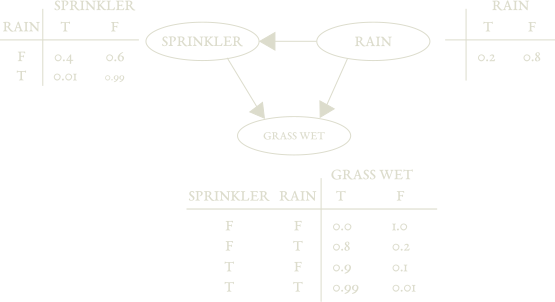 图中的条件概率分布:\(\mathrm{Pr}(R)\), \(\mathrm{Pr}(S\mid R)\), \(\mathrm{Pr}(G\mid S,R)\)
贝叶斯网
图中的联合概率分布:\(\mathrm{Pr}(G,S,R)=\mathrm{Pr}(R)\cdot\mathrm{Pr}(S\mid R)\cdot\mathrm{Pr}(G\mid S,R)\)
贝叶斯网
- 有向无环图(directed acyclic graph, DAG)
- 每条有向边代表一个条件概率关系
- 子节点与其所有父节点构成一个条件概率分布
- 联合概率分布由所有条件概率分布组成
贝叶斯网的概率分布函数
知识在概率模型中的作用
在概率模型中引入知识是为了简化推理的运算与存储复杂度。
- 样本空间大小为 \(2^n\)
- 计算 \(X_i\) 为真的概率(边际概率)需要对 \(2^{n-1}\) 个事件的概率值求和: \[\mathrm{Pr}(X_i)=\sum_{x_{j\neq i}}\mathrm{Pr}(X_1, X_2, \ldots, X_n)\]
蕴涵的语义

Noisy Or
- 原始的 \(\vee\) 若用贝叶斯网来表示需要 \(O(2^n)\) 个参数
- 引入独立性以后将参数缩小为 \(O(n)\) 个

Noisy And
- 原始的 \(\wedge\) 若用贝叶斯网来表示需要 \(O(2^n)\) 个参数
- 引入独立性以后将参数缩小为 \(O(n)\) 个
条件独立性
- \(X_1 \top\!\!\!\top X_2\)
- \(X_1 \perp\!\!\!\perp X_2 \mid Y\)

马尔可夫网
- 通过一种叫做团(clique)的子图来分解随机联合概率分布
- 每个团是一个完全连通图
- 团拥有自己的势函数,用来描述它对联合概率分布的贡献

马尔可夫网的概率分布函数
| \(A\) | \(C\) | \(\phi_{AC}(A,C)\) |
|---|---|---|
| 0 | 0 | 1 |
| 0 | 1 | 10 |
| 1 | 0 | 10 |
| 1 | 1 | 100 |
马尔可夫网中的条件独立
马尔可夫网中的条件独立

合取的语义

析取的语义
蕴涵的语义
马尔可夫逻辑网
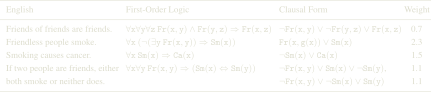
将逻辑公式的语义用马尔可夫网表达,即得到马尔可夫逻辑网(Markov Logic Network, MLN)。
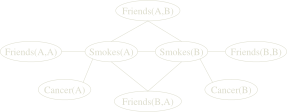
- MLN 可看作用一阶逻辑公式作为模板 生成的具体马尔可夫网
- 将每个具体逻辑公式作为一个团
- 一阶逻辑公式的权重作为势函数的来源

马尔可夫逻辑网
马尔可夫逻辑网
- \(\mathbf{X}\) 为所有命题原子(随机变量)的集合
- \(\phi_i\) 为第 \(i\) 个公式的势函数,是一个指数函数
- \({\color{var(--zenburn-red)}{w_i}}\) 为第 \(i\) 个命题公式的权重
- \({\color{var(--zenburn-blue)}{n_i }}(\mathbf{X})\) 是随机变量取值为 \mathbf{X} 时,命题公式 \(i\) (子句形式)中为真的原子命题个数
符号学习简介・概率逻辑系统
- 从非经典逻辑到概率逻辑
- KBMC
- 分布语义
用逻辑来表达概率
用逻辑来表达概率
用逻辑来表达概率
用逻辑来表达概率
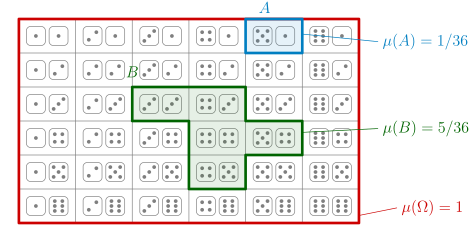
概率空间
- \(\Omega\) 是一个非空集,被称为样本空间
- \(\mathcal{F}\subseteq 2^\Omega\) 是一个 \(\sigma\)-代数,代表可能事件
- 它关于可数并和补运算封闭
- \(\mathrm{Pr}:\mathcal{F}\mapsto[0,1]\) 是概率测度函数
- \(\mathrm{Pr}(\Omega)=1\)
- 它可数可加:若 \(\{A_i\}^\infty_{i=1}\subseteq\mathcal{F}\) 两两不相交,则 \[\mathrm{Pr}(\cup^\infty_{i=1}A_i)=\sum^\infty_{i=1}\mathrm{Pr}(A_i)\]
概率逻辑语言
我们仍然有一个自由代数,它包含一系列基本符号:
- \(\Phi=\{p_1, p_2, \ldots\}\) 为所有的原子命题
- 实数符号
- \(\neg\) 与 \(\vee\) 为逻辑连词
- \(w(\varphi)\) 是一个权重函数,\(\varphi\) 为以上符号构成的公式
- 算数符号
- 大小于符号
概率逻辑结构
四元组 \(M=(\Omega, \mathcal{F}, \mathrm{Pr}, \pi)\) 是一个概率逻辑结构(probabilistic logic structure),其中:
- \((\Omega, \mathcal{F}, \mathrm{Pr})\) 是一个概率空间
- \(\Omega\) 是关于 \(\Phi\) 的所有可能世界
- \(\mathcal{F}\subseteq 2^\Omega\) 是一个 \(\sigma\)-代数
- \(\mathrm{Pr}:\mathcal{F}\mapsto[0,1]\) 是概率测度函数
- \(\pi\) 为真值指派函数,例如:
- 原子命题 \(p\in\Phi\) 在可能世界 \(s\in\Omega\) 中的真值 \(\pi(s)(p)\in\{True,False\}\)
概率逻辑结构的语义
- \(p^M=\{s\in\Omega\mid\pi(s)(p)=True\}\)
- \(\varphi^M=\{s\in\Omega\mid\pi(s)(\varphi)=True\}\)
- \(w^M(p)=\mu(p^M)\)
- \(w^M(\varphi)=\mu(\varphi^M)\)
概率逻辑结构的语义
基于可能世界的推理
考虑一个逻辑理论的 Herbrand universe:
- 每个具体事实可看作一个随机变量;
- 对它们的真值指派可看作一个可能世界(Possible world);
- 每个可能世界中均能够进行纯逻辑推理;
- 对问句(query)求它在所有可能世界中为真的期望;
- 概率分布只需定义在该 Herbrand universe 上即可
分布语义的公理系统
分布语义涵盖了命题逻辑与概率论公理,具体包含了:
- 命题逻辑公理
- 所有命题逻辑重言式
- MP 规则
- 关于线性不等式的一切重言式
- 关于概率论的公理:
- \(0\leq w(\varphi)\leq 1\)
- \(w(True)=1\)
- \(w(\varphi\wedge\psi)+w(\varphi\wedge\neg \psi)=w(\varphi)\)
- \(w(\varphi)=w(\psi)\) 仅当 \(\varphi\equiv\psi\) 是一个命题逻辑中的重言式
概率逻辑程序的例子
%% Probabilistic facts:
0.5::heads1.
0.6::heads2.

%% Rules:
twoHeads :- heads1, heads2.
someHeads :- heads1.
someHeads :- heads2.

%% Queries:
query(twoHeads).
query(someHeads).
prob(twoHeads, 0.3).
prob(someHeads, 0.8).
概率逻辑程序的例子
%% Probabilistic rules:
0.3::stress(X) :- person(X).
0.2::influences(X,Y) :- person(X), person(Y).
0.4::cancer(X) :- smokes(X).

%% Non-probabilistic rules:
smokes(X) :- stress(X).
smokes(X) :- friend(X,Y), influences(Y,X), smokes(Y).

%% Facts
person(angelika).
person(joris).
person(jonas).
person(dimitar).

friend(joris,jonas).
friend(joris,angelika).
friend(joris,dimitar).
friend(angelika,jonas).

%% Query
query(cancer(X)).

%% Output
prob(cancer(angelika), 0.1368).
prob(cancer(dimitar), 0.12).
prob(cancer(jonas), 0.12).
prob(cancer(joris), 0.16920518).
符号学习简介・概率逻辑推断
- 图模型推断
- 从 SAT 到 WMC
- 知识编译
统计关系模型
Startistical Relational AI (StaRAI) 的本质是将 ground rules 转换为布尔随机变量构成的概率图模型(Probabilistic Graphical Model, PGM)。

PGM 中的推理
统计推断(Statistical Inference):
- 通过基于概率分布的计算来回答关于领域的问题。
- \(\mathrm{Pr}(x=1\mid y=4, z=3)\) 的概率是多少?
- \(\mathrm{Pr}(x, y)\) 联合概率分布中最可能出现的 \((X,Y)\) 是什么?
- 联合概率分布 \(\mathrm{Pr}(x,y,z)\) 的熵是多少?
- 明天大盘下跌的概率是多少?
消元法
计算如下边际概率:

消息传递
将边际概率看作“消息传递”(message passing)。考虑如下布尔马尔可夫链:
 其联合概率分布的分解形式为:\(\mathrm{Pr}(a,b,c,d)=\mathrm{Pr}(a\mid b)\mathrm{Pr}(b\mid c)\mathrm{Pr}(c\mid d)\mathrm{Pr}(d)\)
- 第一种方式:直接计算 \(\mathrm{Pr}(a=0)=\sum_{b,c,d}\mathrm{Pr}(a=0\mid b)\mathrm{Pr}(b\mid c)\mathrm{Pr}(c\mid d)\mathrm{Pr}(d)\)
- 共需要计算 \(7\) 次求和。
- 第二种方式:将求和操作分解
- 先将 \(d\) 推进去:
\[\mathrm{Pr}(a=0)=\sum_{b,c}\mathrm{Pr}(a=0\mid b)\mathrm{Pr}(b\mid c)\underbrace{\color{var(--zenburn-blue)}{\sum_d {\mathrm{Pr}(c\mid d) \mathrm{Pr}(d)}}}_{\gamma_d(c)}\]
- 对于 \(\gamma_d(c)\) 需要计算 \(2\) 次求和。
- 先将 \(d\) 推进去:
\[\mathrm{Pr}(a=0)=\sum_{b,c}\mathrm{Pr}(a=0\mid b)\mathrm{Pr}(b\mid c)\underbrace{\color{var(--zenburn-blue)}{\sum_d {\mathrm{Pr}(c\mid d) \mathrm{Pr}(d)}}}_{\gamma_d(c)}\]
消息传递
- 先将 \(\sum_d\) 推进去:
\[\mathrm{Pr}(a=0)=\sum_{b,c}\mathrm{Pr}(a=0\mid b)\mathrm{Pr}(b\mid c)\underbrace{\color{var(--zenburn-blue)}{\sum_d {\mathrm{Pr}(c\mid d) \mathrm{Pr}(d)}}}_{\gamma_d(c)}\]
- 对于 \(\gamma_d(c)\) 需要计算 \(2\) 次求和。
- 再将 \(\sum_c\) 推进去:
\[\mathrm{Pr}(a=0)=\sum_{b}\mathrm{Pr}(a=0\mid b)\underbrace{\color{var(--zenburn-blue)}{\sum_c {\mathrm{Pr}(b\mid c)\gamma_d(c)}}}_{\gamma_c(b)}\]
- 对于 \(\gamma_c(b)\) 需要计算 \(2\) 次求和。
- 最后将 \(\sum_b\) 推进去:
\[\mathrm{Pr}(a=0)=\underbrace{\color{var(--zenburn-blue)}{\sum_b {_{}\mathrm{Pr}(a=0\mid b)\gamma_c(b)}}}_{\gamma_b(a)}\]
- 对于 \(\gamma_b(a)\) 需要计算 \(1\) 次求和。
消息传递
因子图
图模型中用方形节点表示其相邻节点随机变量构成的因子(factor),它是一个非负函数。

马尔可夫网的因子图
 (a)
(a)
 (b)
(b)
 (c)
(c)
- (a) 的势函数因子:\(\phi(a,b,c)\)
- (b) 的势函数因子:\(\phi_1(a,b)\phi_2(b,c)\phi_3(a,c)\)
- (a) 和 (b) 有着相同的马尔可夫网结构 (c)
- 但 (b) 表达了更多关于势函数的约束(例如逻辑规则)
隐马尔可夫模型的因子图

信念传播
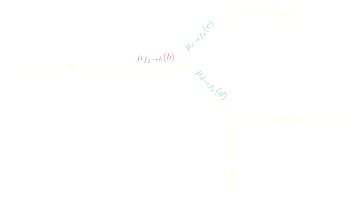
Belief Propagation:
因子图中一个节点只有在完全收集到邻居传来的“信息”时才可以将自己的“信息”传递出去。
\[\mathrm{Pr}(a,b,c,d,e)\propto f_1(a,b)f_2(b,c,d)f_3(c)f_4(d,e)f_5(d)\]
信念传播・Sum-Product
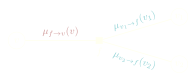
随机变量到因子节点
边界变量(无输入邻居因子)的信息为 \(1\)。
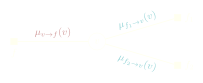
边界因子(无输入邻居变量)的信息为其本身。
符号学习简介・概率逻辑推断
- 图模型推断
- 从 SAT 到 WMC
- 知识编译
可满足性问题(SAT)
输入:
- 一组布尔变量集合(游戏中的 \(1,\ldots,9\))
- 一组形如 \(l_1 \vee \ldots \vee l_k\) 的子句(在游戏中 \(k=3\),因此它是 \(3\)-SAT),其中每个文字 \(l_i\) 是布尔变量或其否定形式
输出:
- 对所有布尔变量的一个真值指派,使得它能够满足(satisfies)所有子句
可满足性问题(SAT)
存在一组解(一个模型)为: \[A=True, B=False, C=True\] 许多时候我们面对的是更一般形式的逻辑表达式,而不仅仅是 \(k\)-CNF(conjunctive normal form,合析范式)
| \(A\) | \(B\) | \(C\) | SAT? |
|---|---|---|---|
| 0 | 0 | 0 | No |
| 0 | 0 | 1 | Yes |
| 0 | 1 | 0 | Yes |
| 0 | 1 | 1 | Yes |
| 1 | 0 | 0 | Yes |
| 1 | 0 | 1 | Yes |
| 1 | 1 | 0 | Yes |
| 1 | 1 | 1 | No |
可满足性问题(SAT)
- 是计算机科学中最基础的问题之一
- 是可计算理论的基石之一,号称“NP 之壁”
- 许多问题能够归约为 SAT,例如规划(planning)、约束求解(constraint solving)、验证(verification)……
- 大型 SAT 问题依然是计算机科学面临解决的核心问题之一,每年都有竞赛,且 SotA 榜一直在更新
- SAT 可以拓展至其他领域,例如模型计数、贝叶斯网中的概率推断等等。
贝叶斯网与 SAT
- 能不能将 SAT 问题转换为一个贝叶斯网推断问题?
- 考虑如下的例子: \[(\neg A\vee B)\wedge(\neg B\vee C)\wedge(A\vee C)\]
贝叶斯网与 SAT
- 给 \(A,B,C\) 各自为真的事件赋概率值 \(0.5\),并令它们到 \(C_1, C_2, C_3\) 的条件概率分布表为以上表达式(例如,\(C_1\) 为真当且仅当 \(\neg A\vee B\))
- 若 \(\mathrm{Pr}(F)>0\) 当且仅当上面的 CNF 可满足
- 因此,贝叶斯网推断的复杂度至少与 SAT 等价(NP-难)
- 那么,\(\mathrm{Pr}(F)=3/8\) 代表什么意思?

从 SAT 到 #SAT 到 WMC
- SAT:对于一个逻辑理论,它的模型是否存在?
- #SAT:一共有多少个模型?(模型计数)
- WMC:若每个模型拥有不同的权重,计数所得的权重是多少?
从 SAT 到 #SAT 到 WMC
从前面的例子可以看出,贝叶斯网的概率推断与带权模型计数有着极强的关联:
- 该例子中的 CNF 一共有 \(3\) 个模型
- 在该贝叶斯网中,每个可能世界有 \(1/8\) 的概率,每个变量为真的概率(权重)为 \(0.5\)。我们可按如下方式定义带权模型计数(weighted model counting, WMC):
- 给定一个逻辑理论 \(T\)(通常为 CNF)
- 它的任意文字 \(l\) 均被赋有一个(非负)权重 \(w(l)\)
- 那么,带权模型计数问题的结果 \(wmc(T)\) 即为:
- \(wmc(T)=\sum_{M\models T}w(M)\),其中 \(M\) 是 \(T\) 的模型(例如 least Herbrand model)
- 假设所有文字之间相互独立,那么 \(w(M)=\prod_{l\in M}w(l)\)
从 SAT 到 #SAT 到 WMC
| \(A\) | \(B\) | \(C\) | 模型? | 权重 | \(wmc(T)\) |
|---|---|---|---|---|---|
| 0 | 0 | 0 | 0 | \(0.5^3\) | \(0\) |
| 0 | 0 | 1 | 1 | \(0.5^3\) | \(0.5^3\) |
| 0 | 1 | 0 | 0 | \(0.5^3\) | \(0\) |
| 0 | 1 | 1 | 1 | \(0.5^3\) | \(0.5^3\) |
| 1 | 0 | 0 | 0 | \(0.5^3\) | \(0\) |
| 1 | 0 | 1 | 0 | \(0.5^3\) | \(0\) |
| 1 | 1 | 0 | 0 | \(0.5^3\) | \(0\) |
| 1 | 1 | 1 | 1 | \(0.5^3\) | \(0.5^3\) |
符号学习简介・概率逻辑推断
- 图模型推断
- 从 SAT 到 WMC
- 知识编译
知识编译
Knowledge Compilation: 将逻辑表达式编译为一个电路(circuit)以进行高效运算
- 编译一次,重复利用
- SAT 求解算法的 DPLL 每次计算都需要从头开始
- 贝叶斯网推断方法中的 SoTA
- 针对不同种类的问题,存在许多电路类型
- 已经被应用在许多领域(软件验证、计算机体系结构、数据挖掘等等)
知识编译
贝叶斯网可以编码为如下布尔表达式: \[ \{(\theta_A \wedge A)\wedge ((\theta_{B\mid A}\wedge B)\vee(\theta_{\neg B\mid A}\wedge\neg B))\}\vee\{(\theta_{\neg A}\wedge A)\wedge((\theta_{B\mid \neg A}\wedge B)\vee(\theta_{\neg B\mid \neg A}\wedge \neg B))\} \]
\(A\):
\begin{eqnarray*} A&\Leftrightarrow&\theta_A\\ \neg A&\Leftrightarrow&\theta_{\neg A} \end{eqnarray*}\(A\rightarrow B\):
\begin{eqnarray*} A\wedge B&\Leftrightarrow&\theta_ {B\mid A}\\ A\wedge \neg B&\Leftrightarrow&\theta_ {\neg B\mid A}\\ \neg A\wedge B&\Leftrightarrow&\theta_ {B\mid \neg A}\\ \neg A\wedge \neg B&\Leftrightarrow&\theta_ {\neg B\mid \neg A} \end{eqnarray*}

知识编译
对应着:
例如,令 \(A=1, B=1\) 可得:
转化为算数电路

可以看到,这里的 \(A,B,\neg A,\neg B\) 均为布尔表达式 \(\theta_x\) 的权重!
转化为算数电路
计算 \(\mathrm{Pr}(A=false)\) 时,只需令权重 \(A=0,\neg A=1, B=1, \neg B=1\)
Max-Product
当需要计算 MPE(most-probable explanation)时,可编译一个 max-product 电路:
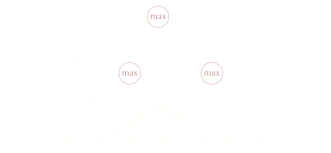
计算 \(\mathop{\arg\max}\limits_b \mathrm{Pr}(A=false, B=b)\) 时,只需令权重 \(A=0,\neg A=1, B=1, \neg B=1\) 并计算上式。
算数电路中的概率推断
- 计算观测变量(或称为证据,evidence)\(\mathrm{Pr}(evidence)\) 的概率只需要重新设置权重:
- 若 \(e=true\) 则令权重 \(e=1\) 且 \(\neg e=0\),反之亦然
- 若 \(v\) 不是观测变量,则令 \(v=1\) 且 \(\neg v=1\)
- 对于所有条件概率表中的条目:令 \(\neg\theta_x=1\) 且 \(\theta_x=CPT(x)\)
- 因为权重可以重新设置,算数电路可被用于多次重复运算
- 仅需要编译一次(花费较高),但以后每次推断速度都很快
- 可类比于信念传播,完成传播后可获得所有变量的边际分布
- 如何保证算数电路能够计算出正确的结果?
- sd-DNNF (smooth, deterministic, Decomposable Negation Normal Form)
d-DNNF 的编译算法

概率规则学习
- 参数学习
- 结构学习
参数学习
- \(\theta\):参数,即概率事实、概率规则的权重
- \(\mathcal{D}\):训练数据,\(\{X=x\}^n_{i=1}\)
参数学习
- 最大似然(ML) \[\theta^*=\mathop{\arg\max}\limits_\theta \mathrm{Pr}(\mathcal{D}\mid\theta,M)\]
- 最大后验概率(MAP) \[\theta^*=\mathop{\arg\max}\limits_\theta \mathrm{Pr}(\theta\mid\mathcal{D},M)\]
- 若 \(\mathrm{Pr}(\theta\mid M)=\text{const.}\),那么 MAP=ML \[\theta^*=\mathop{\arg\max}\limits_\theta \mathrm{Pr}(\theta\mid\mathcal{D},M)=\mathop{\arg\max}\limits_\theta \frac{\mathrm{Pr}(\mathcal{D}\mid\theta,M)\mathrm{Pr}(\theta\mid M)}{\mathrm{Pr}(\mathcal{D}\mid\theta)}=\mathop{\arg\max}\limits_\theta \mathrm{Pr}(\mathcal{D}\mid\theta,M)\]
马尔可夫逻辑的参数估计
\[
\mathrm{Pr}_w(\mathbf{X})=\frac{1}{Z}\prod_i \phi_i (\mathbf{X})=\frac{1}{Z}\exp\left(\sum_i {\color{var(--zenburn-red)}{w_i}} {\color{var(--zenburn-blue)}{n_i }}(\mathbf{X})\right)
\]
马尔可夫逻辑的参数估计
判别式学习:预测条件似然 \(\mathrm{Pr}(y\mid x)\) \[ \mathrm{Pr}(y\mid x)=\frac{1}{Z_x}\exp\left(\sum_{i\in F_Y}w_i n_i (x,y)\right) \]
- \(\color{var(--zenburn-red)}{w_i}\):第 \(i\) 个子句的权重
- \(Z_x\):取值 \(X=x\) 的所有 possible world 权重之和(条件配分函数)
- \(F_Y\):包含问句原子 \(Y\) 的所有子句(马尔可夫毯)
- \(n_i(x,y)\):当变量取值为 \((X,Y)=(x,y)\) 时,第 \(i\) 个子句中为真的原子个数
马尔可夫逻辑的参数估计
生成式学习:预测联合概率似然 \(\mathrm{Pr}(x)\) \[ \mathrm{Pr}_w(X=x)=\frac{1}{Z}\exp\left(\sum_{i\in F} w_i n_i (x)\right) \] 参数 \(w_i\) 关于对数似然函数的梯度 \[ \frac{\partial}{\partial w_i}\log\mathrm{Pr}_w(X=x) = n_i(x) - \sum_{x'}\mathrm{P}_w(X=x')n_i(x') \]
- MCMC 采样,如 WalkSAT
- MAP 估计
马尔可夫逻辑的参数估计
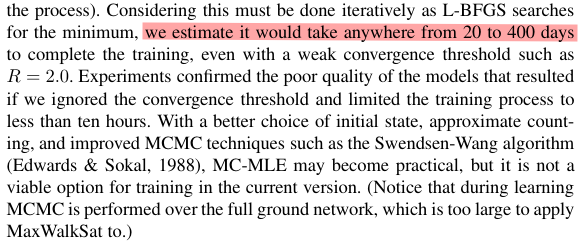
对于含递归规则的一阶概率逻辑问题来说
基于 MCMC (如 Gibbs 采样)的推理基本很难在短时间内收敛
伪似然函数
- \(X_l, l\in\{1,\ldots,n\}\):Markov 网中的所有随机变量(groundings)
- \(MB_x(X_l)\):变量 \(X_l\) 的马尔可夫毯在 \(X=x\) 时的取值
伪似然函数
参数 \(w_i\) 关于对数伪似然函数的梯度
- \(n_i(x_{[X_l=0]})\):在第 \(i\) 个子句中令 \(X=x\) 并强行设置 \(X_l=0\) 时真原子的个数
- 不再需要用 WMC 对全局模型进行推理,速度极快
- 只关心每个 grounding 的局部信息
- 当推理链较长、依赖关系复杂时,准确率非常差
Max-margin Learning
对于判别式学习,除了之间最大化条件对数似然函数,还可以最大化如下“margin”: \[ \frac{\mathrm{Pr}_\mathbf{w}(y|x)}{\mathrm{Pr}_\mathbf{w}(\hat{y}|x)} \]
- 其中 \(\hat{y}\) 是参数 \(\mathbf{w}\) 下随机变量 \(Y\) 除了 \(y\) 以外最可能的赋值: \[\hat{y}=\mathop{\arg\max}\limits_{\bar{y}\in Y\backslash y}\mathrm{Pr}_\mathbf{w}(\bar{y}\mid x)\]
ProbLog 中的参数学习
一阶 ProbLog 的概率分布函数: \[ \mathrm{Pr}(L\mid\mathcal{T})=\prod_{f_n \theta_{n,k}\in L} p_n \prod_{f_n \theta_{n,k}\in L_\mathcal{T}\backslash L} (1-p_n) \] 其中
- \(\{\theta_{n,1},\ldots, \theta_{n,K}\}\) 是第 \(n\) 个一阶概率原子的所有可能变量替换
- \(\mathcal{T}=\mathcal{F}\cup\mathcal{BK}=\{p_1::f_1,\ldots p_N::f_N\}\cup \mathcal{BK}\) 为 ProbLog 程序,其中 \(p_i::f_i\) 为概率原子公式,\(BK\) 是一阶逻辑程序
- 概率原子公式及它们的变量替换定义了一个在其 Herbrand Universe \(L_\mathcal{T}=\{f_1 \theta_{1,1},\ldots, f_1 \theta_{1,K_1},\ldots,f_N \theta_{N,1},\ldots, f_N \theta_{N,K_N}\}\) 上的分布语义
ProbLog 中的参数学习
概率事实 \(\mathcal{F}\)
0.1::burglary.
0.2::earthquake.
0.7::heard(X).
一阶知识库 \(\mathcal{BK}\)
person(mary).
person(john).
alarm :- burglary; earthquake.
calls(X) :- person(X), alarm, heard(X).
\(\mathcal{F}\) 构成的Herbrand Universe 为:
heard(mary), heard(john), burglary, earthquake
ProbLog 中的“解释”
0.1::burglary.
0.2::earthquake.
0.7::heard(X).
person(mary).
person(john).
alarm :- burglary; earthquake.
calls(X) :- person(X), alarm, heard(X).
部分解释(partial interpretation)
\[ \mathrm{Pr}_w((I^+, I^-))=0.1\times 0.7\times(1-0.7)\times\underbrace{(0.2+(1-0.2))}_{\text{earthquake}} \]
LFI-Problog
Learning from Interpretation:
- 从部分或完整观测数据(即证据包含部分/全部 groundings)中学习。
本质上,LFI 是一种最大似然估计:
其中,
- 训练数据 \(\mathcal{D}=\{I_1, \ldots, I_M\}\) 所有 Interpretation 的集合
- \(\theta=\{p_1, p_2, \ldots, p_n\}\) 为所有概率事实的权重
LFI-Problog
- 每个 \(I_m\) 中均包含了所有概率事实的真值
- 第 \(n\) 个概率事实 \(p_n::f_n\) 的参数 \(p_n\) 的估计可通过数数来完成
其中,
- \(m\) 代表第 \(m\) 个解释:\(f_n \theta^m_{n,k}\) 是 \(f_n\) 在 \(I_m\) 中利用第 \(k\) 个替换得到的 grounding
- \(Z_n=\sum_{m=1}^M K_n^m\) 是 \(f_n\) 在所有解释中的 grounding 个数
LFI-Problog
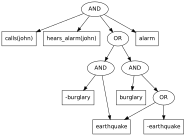
- \(I_m\) 中包含隐变量(无真值指派的 groundings)
- 通过 EM 算法求解
其中计算期望的步中需要将 \(I_m\) 编译为 d-DNNF 来推理隐变量的边际概率。
LFI-Problog
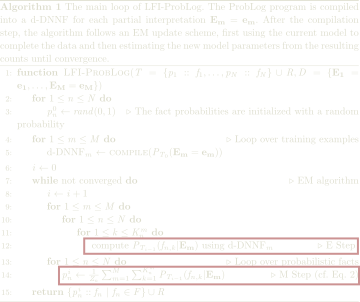
LFI-Problog
概率规则学习
- 参数学习
- 结构学习
结构学习的一般框架
- (初始化)精化规则结构;
- 对该规则结构进行参数优化;
- 评估学习质量,例如用测试数据上的 AUC 或 条件对数似然(CLL)对概率逻辑模型打分;
- 如果达到终止条件则输出
- 否则重复步骤1
Beam search
function Markov_Structure_Learning
    while beam ≠ ∅
        add unit clauses to beam
        while beam has changed
            for each clause c ∈ beam
                c' ← add a literal to c
                newClauses ← newClauses ∪ c'
            end
            beam ← k best clauses in beam ∪ newClauses
        end
        add best clause in beam to MLN
    end
end
Relational Path Finding
- 将常元看作图中的点、谓词看作边
- 多个原子公式的合取看作一条路径
advises(pete, sam), teaches(pete, cs1), tas(sam, cs1).
构成了一条 \((sam,pete,cs1)\) 路径
advises(X, Y), teaches(X, Z), tas(Y, Z).
BUSL
- 利用 relational pathfinding 找到数据中的短路径并泛化
- 将这些路径作为布尔变量 \(\rightarrow\) 马尔可夫网中的节点
- 连接这些节点,形成团簇(cliques)
- 将团簇重构为子句形式
- 对子句打分,并加入模型
BUSL
例如在上面的例子中,可先找到长度小于 2 的短路径
[advises(pete, sam), teaches(pete, cs1)], [tas(sam, cs1)].
利用 Lifting 技术剪枝
Kok and Domingos, ICML’09; ICML’10
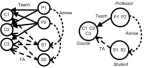
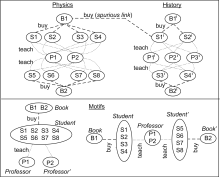
- 利用 relational pathfinding 找到 ground paths
- 根据 ground paths 的结构对领域中的常元进行聚类
- 用 random walk 找到图中具有代表性的子结构
- 常见子图
- 对称路径
- …
其他方法
- 利用 ILP 或其他规则学习技术初始化规则结构
- 利用决策树与集成学习同时归纳规则结构和参数
小结
概率逻辑系统
- 真度与概率的区别
- KBMC:从概率出发,引入逻辑
- 只做概率推断
- 借助逻辑知识结构来建模联合概率分布
- 分布语义:从逻辑出发,引入概率
- 同时进行概率和逻辑推理
- 概率分布从哪来?